


Temperature Control in Food Production: Requirements and Best Practices
How to ensure food safety, product consistency, and regulatory compliance with the right TCU setup
Why Temperature Control Is Non-Negotiable in Food Manufacturing
In food production, temperature is a critical safety variable, not only a process parameter. Incorrect temperatures during processing, pasteurisation, cooling, or storage can lead to bacterial growth, product spoilage, and regulatory violations. Temperature Control Units (TCUs) play a central role in maintaining the precise thermal conditions that food safety and product quality demand.
Key Applications in Food Processing
TCUs are used across virtually every stage of food manufacturing. In chocolate tempering, precise temperature control between 27-32°C determines the crystal structure and final quality of the product. Dairy pasteurisation requires heating to exact temperatures (typically 72°C for 15 seconds in HTST processes) followed by rapid cooling. Cooking and sterilisation processes for canned goods, ready meals, and sauces demand sustained high temperatures with tight tolerances. Cooling applications, from post-processing cooling to jacketed vessel temperature management, require stable, repeatable performance to prevent thermal shock or quality degradation.
Hygienic Design Requirements
Food production environments impose strict requirements on all equipment, including TCUs. Units must be designed for clean-in-place (CIP) compatibility, with stainless steel wetted surfaces that resist corrosion and bacterial buildup. The heat transfer fluid, almost always water in food applications, must remain uncontaminated. This makes indirect cooling essential: factory cooling water must never enter the process loop where it could introduce contaminants.
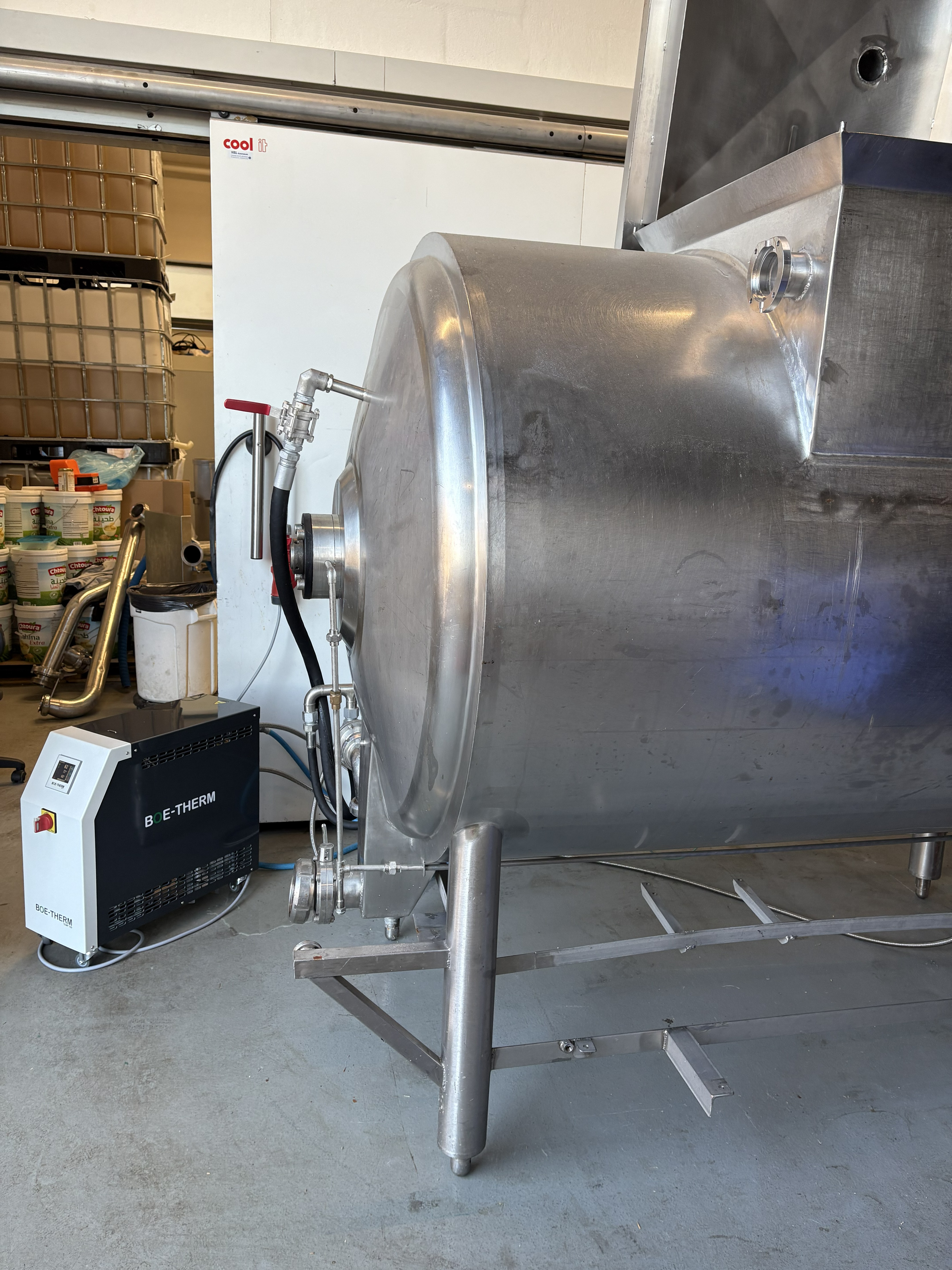
Boe-Therm water TCUs with indirect cooling via plate heat exchangers are specifically suited for food processing environments. The closed process loop maintains water quality while the stainless steel construction meets hygiene standards.
Regulatory Compliance
Food manufacturers operate under strict regulatory frameworks including HACCP, EU food safety regulations, and FDA requirements (for US export). Temperature control is a Critical Control Point (CCP) in most HACCP plans, meaning accurate, documented temperature management is a legal requirement, not optional best practice.
Modern TCUs support compliance through accurate temperature sensing to the tolerance stated in the model's datasheet, data logging capabilities for audit trails, alarm systems for out-of-range conditions, and communication interfaces that integrate with plant-wide SCADA systems for centralised monitoring.
Energy Efficiency in Food Production
Food manufacturing is energy-intensive, and temperature control represents a significant portion of energy consumption. Choosing the right TCU configuration can substantially reduce operating costs. Key considerations include matching heating capacity to actual process requirements rather than over-specifying, sizing the pump to the flow the process actually needs, implementing heat recovery where possible, and selecting units with high-efficiency insulation to minimise heat loss.
Sizing matters more than any single component here. A unit matched to the actual heat load holds the setpoint with fewer heater and pump hours than an oversized one, which carries its standby losses through its whole service life.
Choosing the Right TCU for Food Applications
For most food processing applications, water-based TCUs in the 90-140°C range are appropriate. The specific model depends on process temperature, heating/cooling capacity needed, and flow requirements. Key selection criteria for food applications include stainless steel construction, indirect cooling capability, communication interfaces for SCADA integration, compact footprint for tight production environments, and easy maintenance access for cleaning schedules.
Contact Boe-Therm's engineering team to discuss your specific food processing requirements. We can recommend the optimal TCU configuration based on your process parameters, regulatory environment, and production goals.


Built for your process. Backed by
60 years of experience.

get in touch
info@boe-therm.dk+45 64 71 23 75+49 170 6812 045Our team is ready to help with your specific process requirements. Whether you're looking for TCU specifications, maintenance support, or custom solutions, fill out the form and a Boe-Therm specialist will respond within 24 hours.