


TCU Sizing Guide for Injection Moulding
How to calculate the right heating capacity, flow rate, and temperature range for your moulding process
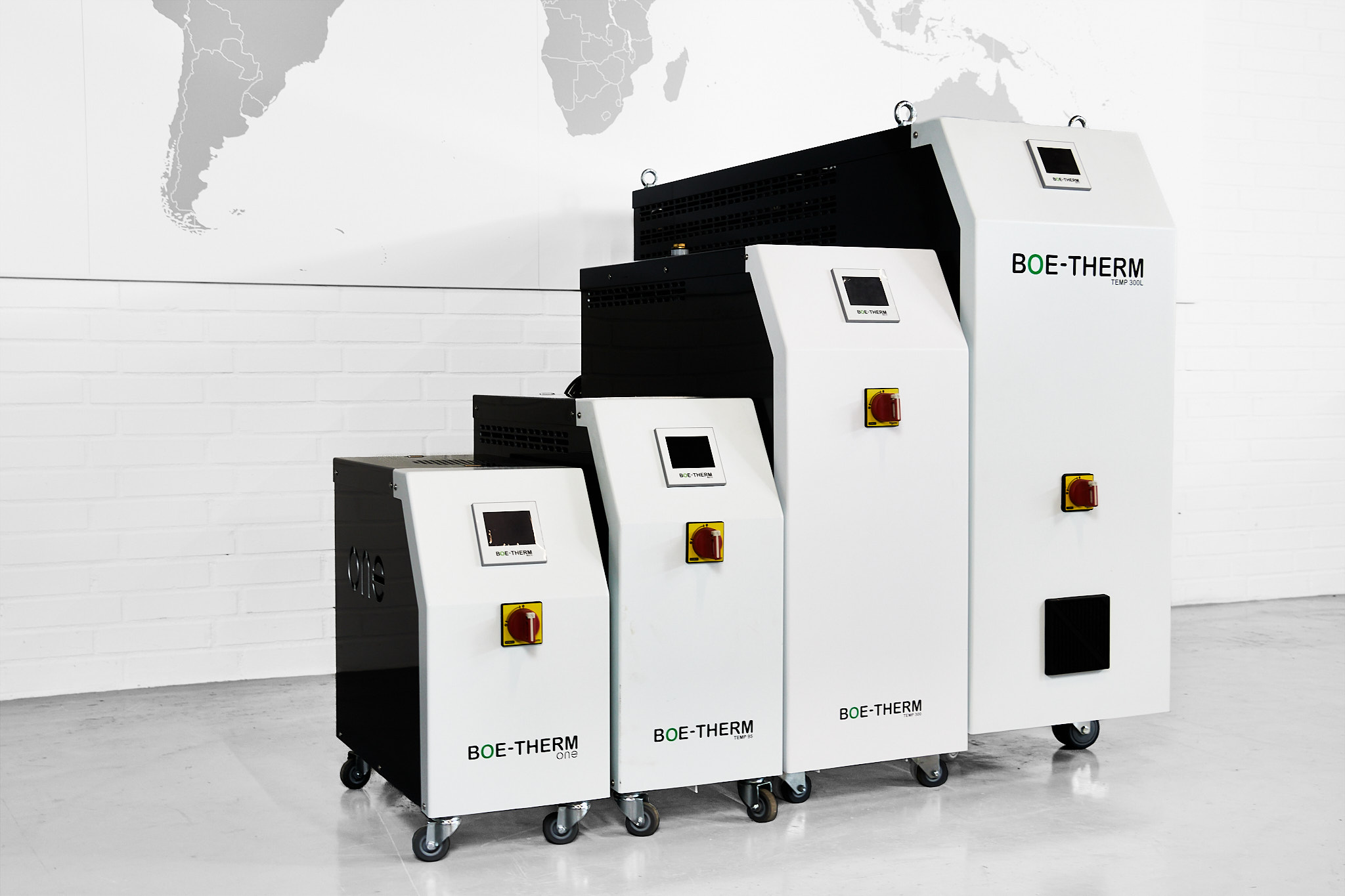
Why Correct TCU Sizing Matters
An undersized Temperature Control Unit cannot maintain stable mould temperatures, leading to longer cycle times, inconsistent part quality, and increased scrap rates. An oversized unit wastes capital and energy. Getting the sizing right is critical for production efficiency and return on investment.
This guide walks through the key parameters you need to determine before selecting a TCU for injection moulding applications.
Step 1: Determine Your Required Temperature Range
The mould temperature requirement depends on the polymer being processed. Common ranges include: ABS and polycarbonate typically require 60-90°C, making a standard water TCU (e.g. Boe-Therm TEMP 95) ideal. Engineering polymers like PEEK or PEI may require 140-180°C, necessitating a pressurised water system (TEMP 140 or TEMP 160) or an oil-based TCU. Standard polyolefins (PP, PE) often run at 20-60°C, where a simpler water unit with a cooling tower connection suffices.
Always design for the highest temperature you might need, not just your current production. This provides flexibility for future material changes without requiring new equipment.
Step 2: Calculate Required Heating Capacity
The heating capacity (in kW) needed depends on the thermal mass of the mould, the target temperature, ambient conditions, and how quickly you need to reach operating temperature. A simplified approach uses the formula: Q = m × c × ΔT / t, where Q is heating power in kW, m is the mass of the mould and heat transfer fluid in kg, c is the specific heat capacity (for steel approximately 0.5 kJ/kg·K), ΔT is the temperature difference from ambient to setpoint, and t is the desired heat-up time in seconds.
For most injection moulding applications with moulds between 200-2000 kg, heating capacities of 9-36 kW are typical. Larger moulds or faster heat-up requirements may need up to 48 kW or more.
Step 3: Determine Flow Rate Requirements
Adequate flow rate through the mould's cooling channels is essential for uniform temperature distribution. Turbulent flow (Reynolds number above 4000) is necessary for effective heat transfer. For typical mould cooling channels with 8-12mm diameter, this requires flow rates of approximately 5-15 litres per minute per circuit.
The total flow rate depends on the number of cooling circuits in your mould. A mould with 4-6 circuits running in parallel will require a TCU pump capacity of 30-80 litres per minute. Boe-Therm TCUs offer pump options from 40 to over 100 litres per minute to match different requirements.
Step 4: Assess Cooling Capacity Needs
During injection moulding, the TCU must remove heat injected by the molten polymer. This cooling demand depends on shot weight, material type, cycle time, and melt temperature. The cooling capacity must at minimum match the heat input from the process to maintain stable temperatures.
Choose between direct cooling (faster response, simpler design, suitable when factory water quality is good) and indirect cooling (protects the TCU from contamination, better for long-term reliability with poor water quality). For critical applications, indirect cooling with a plate heat exchanger is recommended.
Step 5: Consider Control and Communication
Modern injection moulding operations require TCUs that integrate with the overall production system. Key features to look for include PID temperature control, with model-specific control accuracy stated in each datasheet, and a communication interface matched to your machine. Boe-Therm supplies Profinet, Profibus, Ethernet, Modbus RTU, 4-20 mA, 0-10 V and CL (20 mA TTY) for older Arburg, ENGEL, Demag and KraussMaffei machines, programmable setpoint profiles for multi-stage temperature control, and alarm management with automatic shutdown for safety.
Interface requirements are settled in technical dialogue before the order, so the unit arrives ready to talk to the machine you actually run.
Quick Sizing Reference for Common Scenarios
Small moulds (under 500 kg), commodity polymers: TEMP 90 or TEMP 95 with 9-12 kW heating, standard pump.
Medium moulds (500-1500 kg), engineering polymers: TEMP 120 or TEMP 140 with 18-24 kW heating, high-flow pump option.
Large moulds (above 1500 kg) or high-temperature polymers: TEMP 160 or oil-based TEMP 300 with 36+ kW heating, maximum pump capacity.
These are starting points. Every application has unique requirements, and the best approach is to discuss your specific process parameters with a TCU specialist. Contact Boe-Therm’s engineering team for a detailed sizing recommendation based on your exact application.


Built for your process. Backed by
60 years of experience.

get in touch
info@boe-therm.dk+45 64 71 23 75+49 170 6812 045Our team is ready to help with your specific process requirements. Whether you're looking for TCU specifications, maintenance support, or custom solutions, fill out the form and a Boe-Therm specialist will respond within 24 hours.