


Why Your 20-Year-Old TCU Specification Is Costing You Money
Most production facilities replace their temperature control units based on what they had before. Here is why that approach leads to oversized equipment, wasted energy, and unnecessary cost.
The Same as Last Time Problem
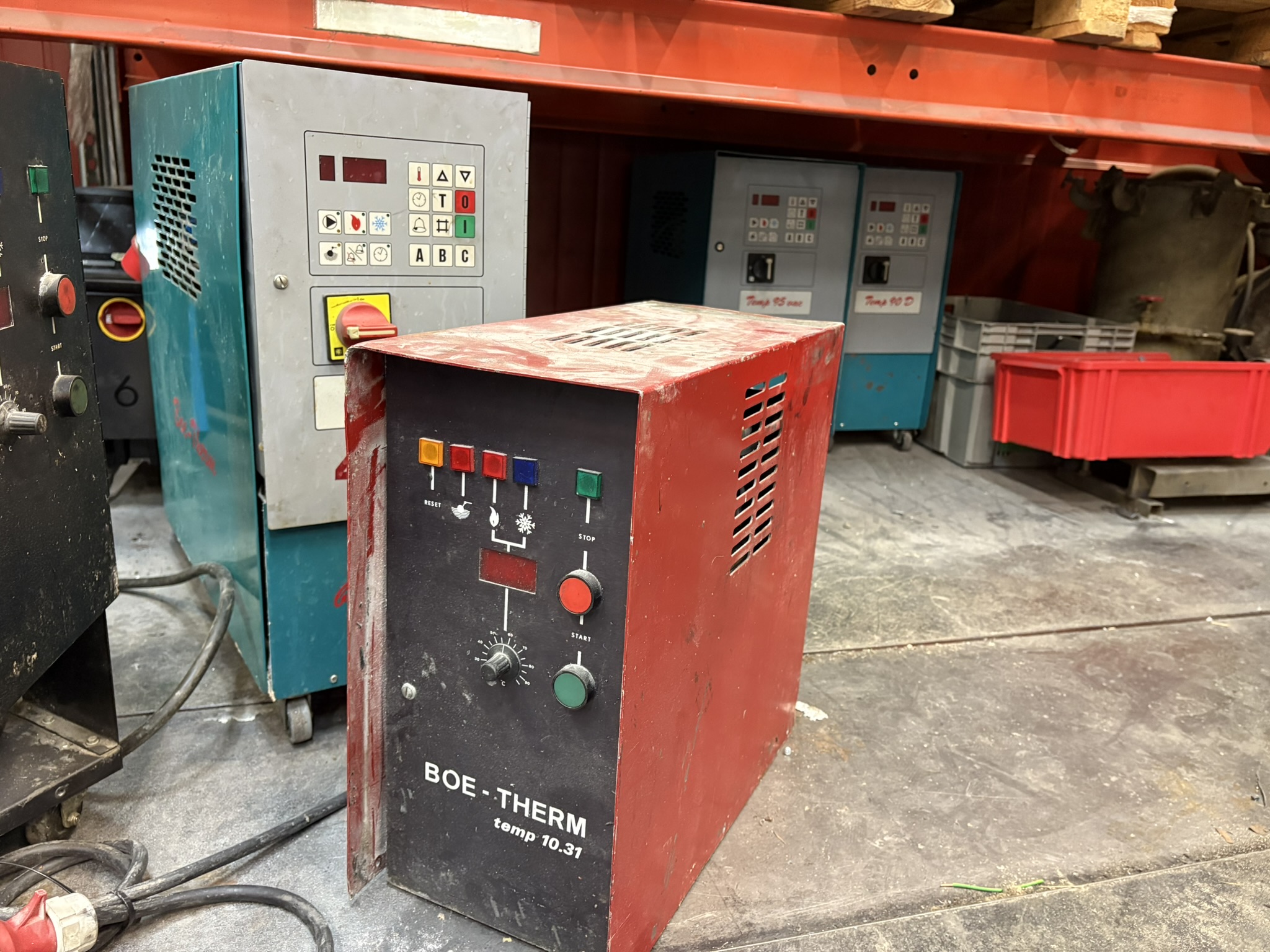
When a temperature control unit reaches end of life, typically after 15 to 25 years of service, the replacement process usually follows a familiar pattern: someone checks the nameplate on the old unit, notes the heating capacity, pump size, and temperature range, and orders the same thing again.
It makes sense on the surface. The old unit worked. Production ran. Why change?
Because the process it was originally specified for has almost certainly changed. Moulds are different. Materials have changed. Cycle times have been optimised. The cooling water temperature may have shifted. And the original specification may not have been accurate in the first place, it might have been oversized just to be safe, or it might have been whatever the supplier had in stock at the time.
The result: you end up with a unit that does not match your actual process requirements. And that mismatch costs money in ways that are not always obvious.
What Happens When a TCU Is Oversized
An oversized TCU does not just cost more upfront. It creates ongoing inefficiency.
A unit with 18 kW of heating capacity controlling a process that only requires 6 kW will cycle its heaters on and off more frequently, which reduces temperature stability. The pump may deliver 80 L/min when the process only needs 30 L/min, wasting energy and creating unnecessary pressure on hoses and fittings.
Oversized equipment also takes up more floor space, consumes more power at standby, and represents a higher capital investment, all without delivering better results.
What Happens When a TCU Is Undersized
The opposite problem is equally costly, though the symptoms are different. An undersized unit struggles to maintain setpoint during production, leading to temperature fluctuations that directly affect product quality.
In injection moulding, this means longer cycle times as the unit fights to recover temperature after each shot. In extrusion, it means inconsistent melt temperature and dimensional variation. In die casting, it means thermal fatigue and premature mould wear.
The production team may not even recognise the TCU as the root cause. They see scrap rates, cycle time drift or surface defects, and look for answers elsewhere.
How to Calculate What You Actually Need
The correct approach is to calculate the required heating and cooling capacity based on the actual process parameters, not the old nameplate.
Heating capacity depends on the thermal mass of the tooling, the target temperature, the ambient start temperature, and how quickly you need to reach setpoint.
Cooling capacity depends on how much heat the process injects into the circuit. In injection moulding, this is primarily the heat from the molten polymer that needs to be removed each cycle. The cooling requirement often exceeds the heating requirement, but many TCU specifications focus only on heating.
Flow rate and pressure depend on the circuit design: hose lengths, diameters, number of parallel circuits, and the geometry of the cooling channels in the mould or tool.
Why Nobody Does This Calculation
The honest answer: because it is complicated, and most TCU suppliers do not make it easy. You either need to do the thermodynamics yourself, or you rely on the suppliers sales team to do it for you, which often results in a recommendation biased toward their standard models.
A Better Approach
We built a free online TCU configurator that does exactly this. You enter your process type, material, operating temperature, tooling mass, and cycle parameters. The tool calculates the actual heating capacity, cooling capacity, and flow rate your process requires, and recommends a specific TCU configuration that matches.
No registration required to use the calculator. No sales call needed. Just engineering.
Try it at boe-therm.com/configurator.
Whether you end up choosing a Boe-Therm unit or not, you will have a specification based on your actual process, not a 20-year-old nameplate.


Built for your process. Backed by
60 years of experience.

get in touch
info@boe-therm.dk+45 64 71 23 75+49 170 6812 045Our team is ready to help with your specific process requirements. Whether you're looking for TCU specifications, maintenance support, or custom solutions, fill out the form and a Boe-Therm specialist will respond within 24 hours.